TYPES OF DIFFERENTIAL EQUATIONS
Types[edit]
Differential equations can be divided into several types. Apart from describing the properties of the equation itself, these classes of differential equations can help inform the choice of approach to a solution. Commonly used distinctions include whether the equation is ordinary or partial, linear or non-linear, and homogeneous or heterogeneous. This list is far from exhaustive; there are many other properties and subclasses of differential equations which can be very useful in specific contexts.
Ordinary differential equations[edit]
An ordinary differential equation (ODE) is an equation containing an unknown function of one real or complex variable x, its derivatives, and some given functions of x. The unknown function is generally represented by a variable (often denoted y), which, therefore, depends on x. Thus x is often called the independent variable of the equation. The term "ordinary" is used in contrast with the term partial differential equation, which may be with respect to more than one independent variable.
Linear differential equations are the differential equations that are linear in the unknown function and its derivatives. Their theory is well developed, and in many cases one may express their solutions in terms of integrals.
Most ODEs that are encountered in physics are linear. Therefore, most special functions may be defined as solutions of linear differential equations (see Holonomic function).
As, in general, the solutions of a differential equation cannot be expressed by a closed-form expression, numerical methods are commonly used for solving differential equations on a computer.
Partial differential equations[edit]
A partial differential equation (PDE) is a differential equation that contains unknown multivariable functions and their partial derivatives. (This is in contrast to ordinary differential equations, which deal with functions of a single variable and their derivatives.) PDEs are used to formulate problems involving functions of several variables, and are either solved in closed form, or used to create a relevant computer model.
PDEs can be used to describe a wide variety of phenomena in nature such as sound, heat, electrostatics, electrodynamics, fluid flow, elasticity, or quantum mechanics. These seemingly distinct physical phenomena can be formalized similarly in terms of PDEs. Just as ordinary differential equations often model one-dimensional dynamical systems, partial differential equations often model multidimensional systems. Stochastic partial differential equations generalize partial differential equations for modeling randomness.
Non-linear differential equations[edit]
A non-linear differential equation is a differential equation that is not a linear equation in the unknown function and its derivatives (the linearity or non-linearity in the arguments of the function are not considered here). There are very few methods of solving nonlinear differential equations exactly; those that are known typically depend on the equation having particular symmetries. Nonlinear differential equations can exhibit very complicated behaviour over extended time intervals, characteristic of chaos. Even the fundamental questions of existence, uniqueness, and extendability of solutions for nonlinear differential equations, and well-posedness of initial and boundary value problems for nonlinear PDEs are hard problems and their resolution in special cases is considered to be a significant advance in the mathematical theory (cf. Navier–Stokes existence and smoothness). However, if the differential equation is a correctly formulated representation of a meaningful physical process, then one expects it to have a solution.[11]
Linear differential equations frequently appear as approximations to nonlinear equations. These approximations are only valid under restricted conditions. For example, the harmonic oscillator equation is an approximation to the nonlinear pendulum equation that is valid for small amplitude oscillations (see below).
Equation order and degree[edit]
The order of the differential equation is the order of the highest derivative of the unknown function that appears in it. When a differential equation is written as a polynomial equation in the unknown function and its derivatives, its degree is, depending on the context, the degree in the highest derivative of the unknown function,[12] or its total degree in the unknown function and its derivatives. In particular, a linear differential equation has degree one for both meanings, but the non-linear differential equation is of degree one for the first meaning but not for the second one.

An equation containing only first derivatives is a first-order differential equation, an equation containing the second derivative is a second-order differential equation, and so on.[13][14]
Differential equations that describe natural phenomena almost always have only first and second order derivatives in them, but there are some exceptions, such as some form of the thin-film equation, which is a fourth order partial differential equation.
Examples[edit]
In the first group of examples u is an unknown function of x, and c and ω are constants that are supposed to be known. Two broad classifications of both ordinary and partial differential equations consist of distinguishing between linear and nonlinear differential equations, and between homogeneous differential equations and heterogeneous ones.
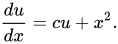
- Heterogeneous first-order linear constant coefficient ordinary differential equation:
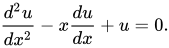
- Homogeneous second-order linear ordinary differential equation:
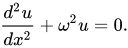
- Homogeneous second-order linear constant coefficient ordinary differential equation describing the harmonic oscillator:
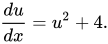
- Heterogeneous first-order nonlinear ordinary differential equation:
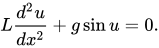
- Second-order nonlinear (due to sine function) ordinary differential equation describing the motion of a pendulum of length L:
In the next group of examples, the unknown function u depends on two variables x and t or x and y.
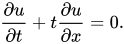
- Homogeneous first-order linear partial differential equation:
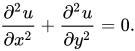
- Homogeneous second-order linear constant coefficient partial differential equation of elliptic type, the Laplace equation:
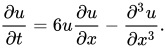
- Homogeneous third-order non-linear partial differential equation:
Existence of solutions[edit]
Solving differential equations is not like solving algebraic equations. Not only are their solutions often unclear, but whether solutions are unique or exist at all are also notable subjects of interest.
For first order initial value problems, the Peano existence theorem gives one set of circumstances in which a solution exists. Given any point in the xy-plane, define some rectangular region , such that and is in the interior of . If we are given a differential equation and the condition that when , then there is locally a solution to this problem if and are both continuous on . This solution exists on some interval with its center at . The solution may not be unique. (See Ordinary differential equation for other results.)


![{\displaystyle Z=[l,m]\times [n,p]}](https://wikimedia.org/api/rest_v1/media/math/render/svg/515b71ad3b5fc01ff532df8cb71018baca811973)


However, this only helps us with first order initial value problems. Suppose we had a linear initial value problem of the nth order:

such that

For any nonzero , if and are continuous on some interval containing , is unique and exists.[15]


Comments
Post a Comment