HILBERT SPACES
Hilbert spaces[edit]

Complete inner product spaces are known as Hilbert spaces, in honor of David Hilbert.[51] The Hilbert space with inner product given by

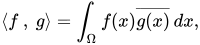


By definition, in a Hilbert space any Cauchy sequence converges to a limit. Conversely, finding a sequence of functions with desirable properties that approximates a given limit function, is equally crucial. Early analysis, in the guise of the Taylor approximation, established an approximation of differentiable functions by polynomials.[53] By the Stone–Weierstrass theorem, every continuous function on can be approximated as closely as desired by a polynomial.[54] A similar approximation technique by trigonometric functions is commonly called Fourier expansion, and is much applied in engineering, see below.[clarification needed] More generally, and more conceptually, the theorem yields a simple description of what "basic functions", or, in abstract Hilbert spaces, what basic vectors suffice to generate a Hilbert space in the sense that the closure of their span (that is, finite linear combinations and limits of those) is the whole space. Such a set of functions is called a basis of its cardinality is known as the Hilbert space dimension.[nb 12] Not only does the theorem exhibit suitable basis functions as sufficient for approximation purposes, but also together with the Gram–Schmidt process, it enables one to construct a basis of orthogonal vectors.[55] Such orthogonal bases are the Hilbert space generalization of the coordinate axes in finite-dimensional Euclidean space.


![[a,b]](https://wikimedia.org/api/rest_v1/media/math/render/svg/bc220c59120619c6b577fecaa3eea299bfb00a5e)

The solutions to various differential equations can be interpreted in terms of Hilbert spaces. For example, a great many fields in physics and engineering lead to such equations and frequently solutions with particular physical properties are used as basis functions, often orthogonal.[56] As an example from physics, the time-dependent Schrödinger equation in quantum mechanics describes the change of physical properties in time by means of a partial differential equation, whose solutions are called wavefunctions.[57] Definite values for physical properties such as energy, or momentum, correspond to eigenvalues of a certain (linear) differential operator and the associated wavefunctions are called eigenstates. The spectral theorem decomposes a linear compact operator acting on functions in terms of these eigenfunctions and their eigenvalues.[58]


Comments
Post a Comment